
Reviewed · ALTIPLANIC LAGOONS & SALT FLATS
From San Pedro de Atacama: The Salt Flats Route, Full Day
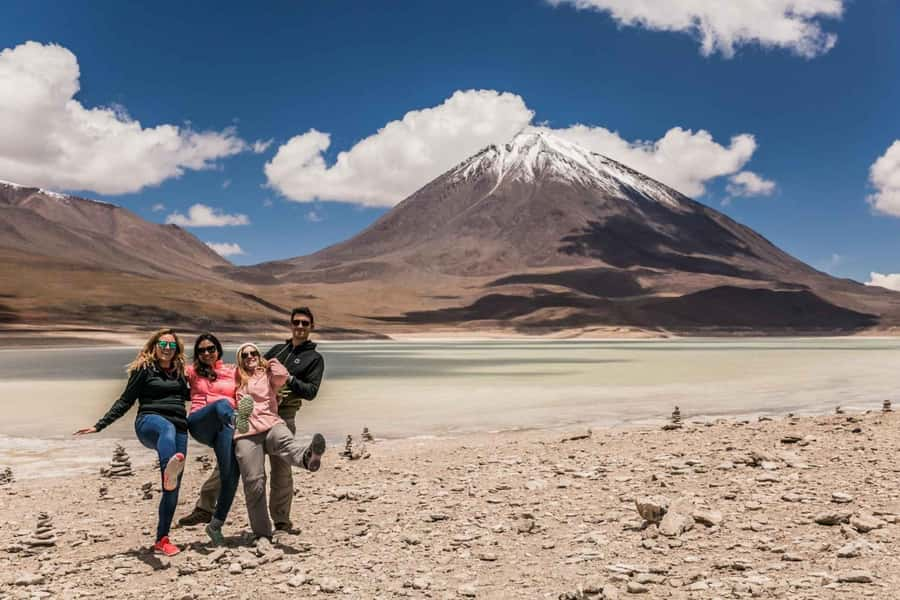
The striking part of this trip is the climb from San Pedro into the high plateau, where the road runs between lava and ash toward the border with Argentina. Licancábur volcano, rising to 5,916 meters, gives the early route a powerful focal point, while Salar de Tara brings wide salt flats, strange rock forms, and flamingos at 4,500 meters.
I like the mix of nature and geology. You get more than a salt flat photo stop: there are high-altitude lakes, possible groups of ostriches, flamingos, and the Pakana formations, including the Moai de Tara. I also like the reasonable 8:00 departure, which means extra sleep compared with very early mountain outings. The main drawback is simple but important: there are no toilets along the whole way, and the cold wind can bite.
Key things to know before booking
- Licáncabur at 5,916 meters: The volcano appears from a high crossing near the route to Hito Cajón Norte.
- Salar de Tara at 4,500 meters: This is the main high-plateau stop, with salt formations, open views, and an unusual bird habitat.
- Pakana rock formations: Look for the Farellón de Tara, Moai de Tara, and the Pakana Cathedrals.
- Wildlife is part of the route: Flamingos, other birds, and possible groups of ostriches add life to an otherwise stark setting.
- Breakfast and a snack are included: Meals and drinks beyond those provisions are not included.
- Prepare for basic conditions: Shared transport, high altitude, cold wind, and no toilets require a little planning.
From San Pedro to the high plateau
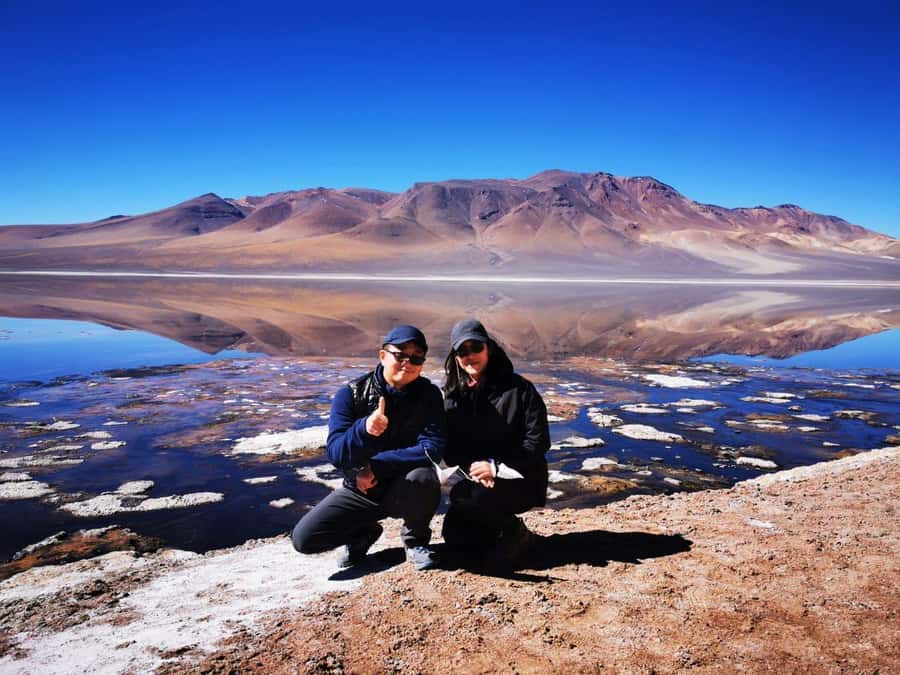
The trip begins at 8:00 in San Pedro de Atacama and follows the international road toward Paso de Jama. You leave the town’s oasis behind and climb along a route shaped by lava and volcanic ash.
That change in scenery is the point. San Pedro sits in a dry basin, while the road gradually rises into a colder, barer world. Along the way, you stop for a broad view back toward the Salar de Atacama and the oasis of San Pedro de Atacama. This gives you useful scale: the town and salt basin look small below, while the surrounding volcanoes and high country take over the horizon.
Breakfast is included at the start of the experience. It is a practical touch, since the route continues far from town and there are no regular food stops listed. A snack is also included, but you should bring any extra water or food you know you will need. Drinks and other meals are not part of the price.
The road is shared rather than private. That keeps the cost at $78 per person, but it also means you should expect a group setting and a fixed route. A bilingual guide leads the outing in Spanish and English. One guide specifically praised for making the stops enjoyable was Marta, though the guide for your departure may be different.
More Lagoon Trips in San Pedro de Atacama
- Piedras Rojas, Altiplanics Lagoons & Salar Full-Day Tour
★ 4.7 · 592 reviews - San Pedro Atacama: Baltinache Lagoons
★ 4.6 · 359 reviews - Triple tour: Red stones, highland lagoons and Chaxa Lagoon
★ 4.7 · 219 reviews
Licáncabur from the 4,200-meter crossing
At about kilometer 41, the route reaches roughly 4,200 meters. A crossing or detour toward Hito Cajón Norte provides the view of Licáncabur volcano, whose summit reaches 5,916 meters.
Licáncabur is not just a distant mountain name on a map. Its clean volcanic shape gives the high plateau a strong visual center, and the sight helps explain the volcanic forces behind the region’s lava, ash, salt, and rock formations.
This is also where the altitude becomes a serious part of the experience. The route continues higher after this point, eventually reaching Salar de Tara at 4,500 meters. You should take the pace slowly, listen closely to your body, and avoid treating the day like a normal lowland sightseeing drive. The provided details do not specify medical support or an acclimatization plan, so personal preparation matters.
The road itself is part of the attraction. It rises steadily through an austere setting where color comes from volcanic rock, pale salt, blue sky, and occasional patches of water. You will not find cafés, shops, or facilities spread along the route. That makes the views feel remote, but it also makes the lack of toilets more than a minor inconvenience.
Lakes, flamingos, and high-plateau wildlife
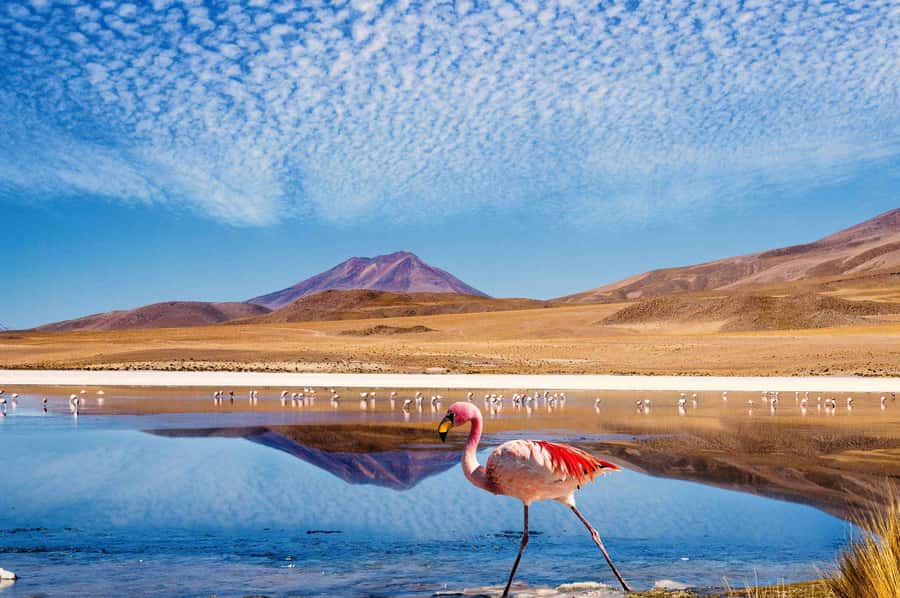
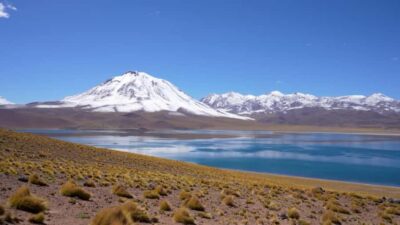
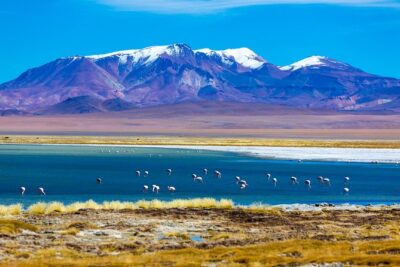
Near kilometer 75, small lakes appear among the high mountains. These pools support flamingos and other birds, giving you a chance to see wildlife in a place that first looks almost lifeless.
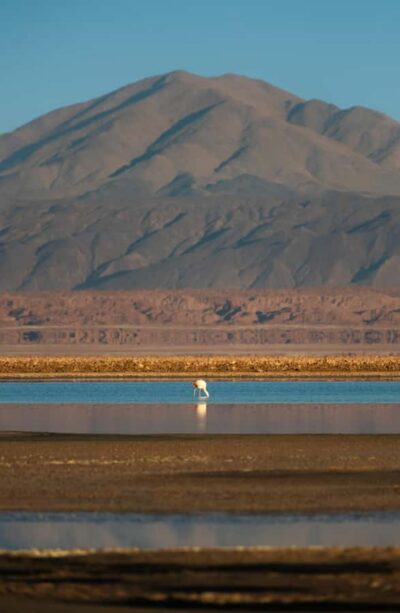
The flamingos are one of the most appealing parts of the route because they add movement and color to the salt country. The exact number and viewing distance can vary, so bring patience rather than expecting a guaranteed close-up. You may also see groups of ostriches along the road.
This combination of wildlife and extreme altitude is what gives the trip more value than a simple salt-flat photo stop. You are seeing how birds and other animals use small pockets of water in a harsh environment. The salt flats are not only white ground and big horizons. They are also feeding and nesting areas for species adapted to the high plateau.
Bring warm layers even if San Pedro is sunny when you leave. The wind can feel sharp once you stop outside, and there is little shelter in the open country. A hat and secure clothing will make the photo stops much more pleasant.
The Farellón de Tara and Moai de Tara
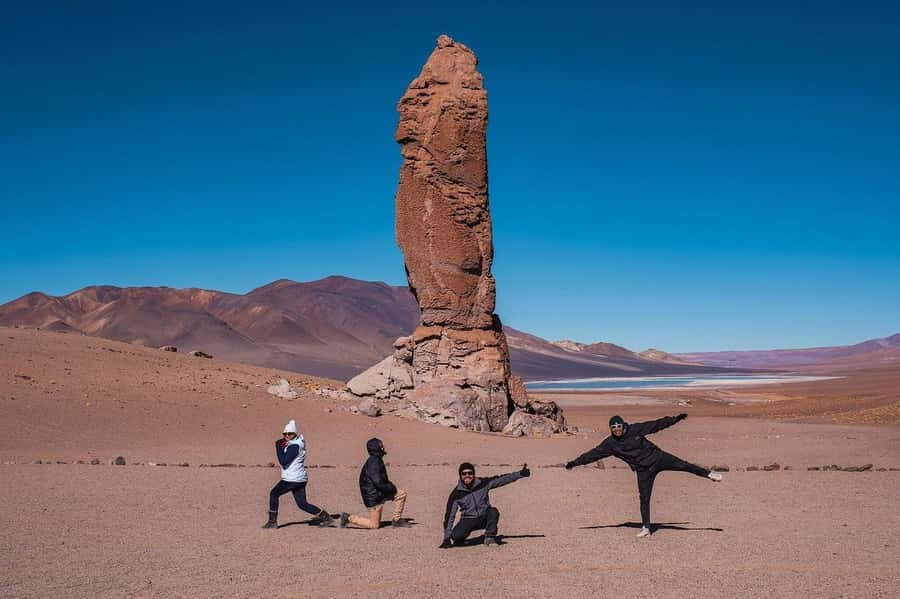
At about kilometer 91, the route passes through the hills of Pakana and circles the Farellón de Tara, a rock wall shaped into large natural sculptures.
This is one of the most distinctive sections of the day. The formations are not polished monuments or built attractions. They are the result of volcanic and geological forces, left in forms that invite comparison with human-made structures.
A little farther on, you reach an esplanade with the Moai de Tara, also called the Pakana Witness. These are groups of tall rock columns preserved from volcanic events during the Tertiary period. Their upright shapes explain the Moai nickname, though the appeal is geological rather than archaeological.
I like this stop because it gives the day a sense of variety. Licáncabur is a volcano, the lakes bring wildlife, and the Pakana formations feel like a natural sculpture garden. You get a clearer picture of how the plateau was built over time, rather than seeing the salt flats as an isolated oddity.
The wide open setting also makes these formations difficult to judge from a photograph alone. Their scale comes from the empty ground around them. Give yourself time to look at the rock walls, columns, and ridges instead of rushing straight to a single picture.
More lagoon and salt flat days from San Pedro de Atacama
- Red Stones and Altiplanic Lagoons
★ 5.0 · 151 reviews - San Pedro de Atacama: Red Rocks & Altiplano Lagoons Day Trip
★ 4.9 · 108 reviews - Altiplanic Lagoons & Piedras Rojas Tour from San Pedro de Atacama
★ 4.5 · 87 reviews - Full Day Tour Piedras Rojas Altiplanic Lagoons Chaxa Lagoon
★ 5.0 · 75 reviews
The Pakana Cathedrals and Salar de Tara
After the Moai de Tara, the route continues to a panoramic view of the Pakana Cathedrals. These formations create another strong geological scene, with tall rock shapes rising from the open plateau.
The final major destination is Salar de Tara, at about 4,500 meters. This salt lake has a distinct ecosystem, and flamingos are among the most common birds found there. The setting is broad and quiet, with salt, rock, water, and distant mountains sharing the same view.
The word salt flat can suggest a smooth white plain, but Salar de Tara is more varied. Its appeal comes from the relationship between the salt lake, the rock structures, and the wildlife. You may find the setting more dramatic than a simple flat expanse because the Pakana formations give the horizon shape.
The route description places several major sights into a six-hour experience. That makes this a compact way to see the area, but it also means stops are likely to be time-conscious. You should book it for a strong overview of the high plateau, not for a slow, private photography trip with long periods at each site.
What the $78 price covers
At $78 per person, the price is fair for a shared day route that includes pickup, transport, a bilingual guide, breakfast, and a snack. You are paying for access to a remote circuit that would be difficult to organize independently, especially with several stops spread across the border road and the Salar de Tara area.
The value is strongest if you want to see several kinds of scenery in one outing. You get views of San Pedro and the Salar de Atacama, Licáncabur, bird-filled lakes, Pakana rock formations, and Salar de Tara. If your main goal is only flamingos, a shorter lagoon trip may suit you better. If you want geology and high-country scenery as well, this route earns its place.
Entrance fees are not included, and the details provided do not specify the amount. Meals and drinks other than breakfast and the snack are also excluded. Check the current fee information before you commit so the low headline price does not catch you off guard.
The rating information available for this experience is mixed, with an overall score of 3.7 from three ratings. The strongest praise centers on the route itself and the guide experience, including a five-star account that singled out Marta. One serious problem involved finding the meeting point, so do not leave pickup details until the last minute. Confirm the exact location and arrive early.
Cold wind, altitude, and the toilet problem
The most useful practical warning is the absence of toilets for the entire route. Plan carefully before departure, and take this into account if long stretches without facilities are difficult for you.
Cold wind is another real concern. San Pedro’s daytime weather can give you the wrong idea about conditions at 4,200 to 4,500 meters. Pack a warm outer layer, and keep it accessible rather than buried in your bag.
The altitude also changes how you should approach the day. The route climbs steadily and reaches heights well above San Pedro. Move slowly during stops and allow extra time for simple tasks such as walking to a viewpoint or getting in and out of the vehicle.
The activity lasts six hours, with departure at 8:00. This is a useful middle ground: you do not need the earliest possible start, but you still cover a high-altitude route before the day gets long. The exact starting time should be checked when booking, since availability can vary.
Free cancellation is available up to 24 hours before the activity for a full refund. You can also reserve now and pay later, which helps if your San Pedro schedule may change. These policies are useful, but they do not remove the need to confirm the meeting point.
Who should book the Salt Flats Route
I would choose this outing if you want a compact introduction to the high plateau, especially if rock formations interest you as much as salt and flamingos. The mix of Licáncabur, Pakana geology, bird habitats, and Salar de Tara gives you more variety than a single-destination trip.
It suits visitors who are comfortable with shared transport, basic conditions, cold wind, and a route without toilets. You should also be ready for high altitude and for a schedule that fits several major sights into six hours.
I would think twice if you need frequent facilities, want a relaxed private outing, or are looking for a meal-inclusive experience. The meeting-point instructions deserve extra attention, too. Confirm where to go, arrive early, and do not assume that being near the pickup area is enough.
For the right visitor, this is a good-value way to see a remote side of northern Chile without paying for a private vehicle. The best reasons to book are the Pakana rock formations, the chance to see flamingos and other birds at high-altitude lakes, and the view of Licáncabur. The main reasons to pass are the toilet issue, possible cold, and the compressed six-hour schedule.
FAQ
How long does the Salt Flats Route take?
The activity lasts 6 hours. Departure is listed for 8:00, though you should check current availability for the exact starting time.
What languages does the guide speak?
The live guide service is offered in Spanish and English.
Is breakfast included?
Yes. Breakfast and a snack are included. Other meals and drinks are not included.
Does the tour include transport?
Yes. Pickup and shared transport are included.
What is the highest point mentioned on the route?
The route reaches Salar de Tara at about 4,500 meters. A crossing near kilometer 41 is described at about 4,200 meters, with views of Licáncabur, whose summit is 5,916 meters high.
Are there toilets along the route?
No. There are no toilets available along the whole way, so plan before departure.
More Full-Day in San Pedro de Atacama
- Full Day Tour to Geyser del Tatio, Vado Putana and Machuca
★ 5.0 · 134 reviews - Full Day Tour to Ruta de los Salares
★ 5.0 · 105 reviews - From San Pedro de Atacama: The Salt Flats Route, Full day
★ 4.4 · 15 reviews - Andean Saltflats full-day with breakfast and lunch
★ 3.6 · 6 reviews
Just added around San Pedro de Atacama
- Vallecito★ 4.7 · 13 reviews
- Valle de la Luna: A Moon-Like Escape in Atacama★ 5.0 · 3 reviews
- Atacama Desert and Magic Bus Visit★ 4.8 · 15 reviews
- San Pedro de Atacama: Valle de la luna★ 3.0 · 3 reviews
- Valley of the moon★ 5.0 · 50 reviews
- San Pedro de Atacama: Half day Valle de la Luna, Afternoon Tour★ 4.5 · 52 reviews
- Piedras Rojas and Altiplanic Tour★ 4.5 · 38 reviews
- Unique 3-Day Tour in San Pedro de Atacama★ 4.5 · 43 reviews
Altiplanic Lagoons & Salt Flats, compared.
Piedras Rojas, Altiplanics Lagoons & Salar Full-Day Tour
Read our review →
Portillo and Laguna del Inca Day Trip with Picnic
Read our review →
Triple tour: Red stones, highland lagoons and Chaxa Lagoon
Read our review →
Altiplanic Lagoons & Piedras Rojas Tour from San Pedro de Atacama
Read our review →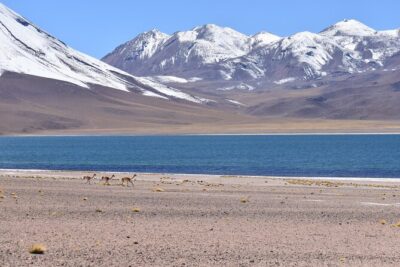
Full Day Tour Piedras Rojas Altiplanic Lagoons Chaxa Lagoon
Read our review →Browse the lists this tour appears in